On Type I and II Errors, False Positives and False Negatives
If you know people confused about all these, here is a helpful representation

In science, it is possible to propose hypotheses and test them by collecting data from experiments, observations, or other procedures.
There are at least two alternative hypotheses for a given situation: either that a relation does not exist (this is often described as the “null” hypothesis) or that a relation does in fact exist.
This can be made clearer by using a legal analogy:
• The suspect is innocent, or there is no relation to the crime (null hypothesis).
• The suspect is guilty, or there is a relation to the crime (alternative hypothesis).
In this case, there are two kinds of errors that are possible:
• Type I error: Reject the null hypothesis when it is true, that is, find a relation when it does not really exist; this entails wrongly convicting an innocent person.
• Type II error: Do not reject the null hypothesis even though it is false, that is, do not find a relation although it does exist; this entails wrongly failing to convict a guilty person.
I have used ChatGPT and some manual editing to produce a visualisation of this.
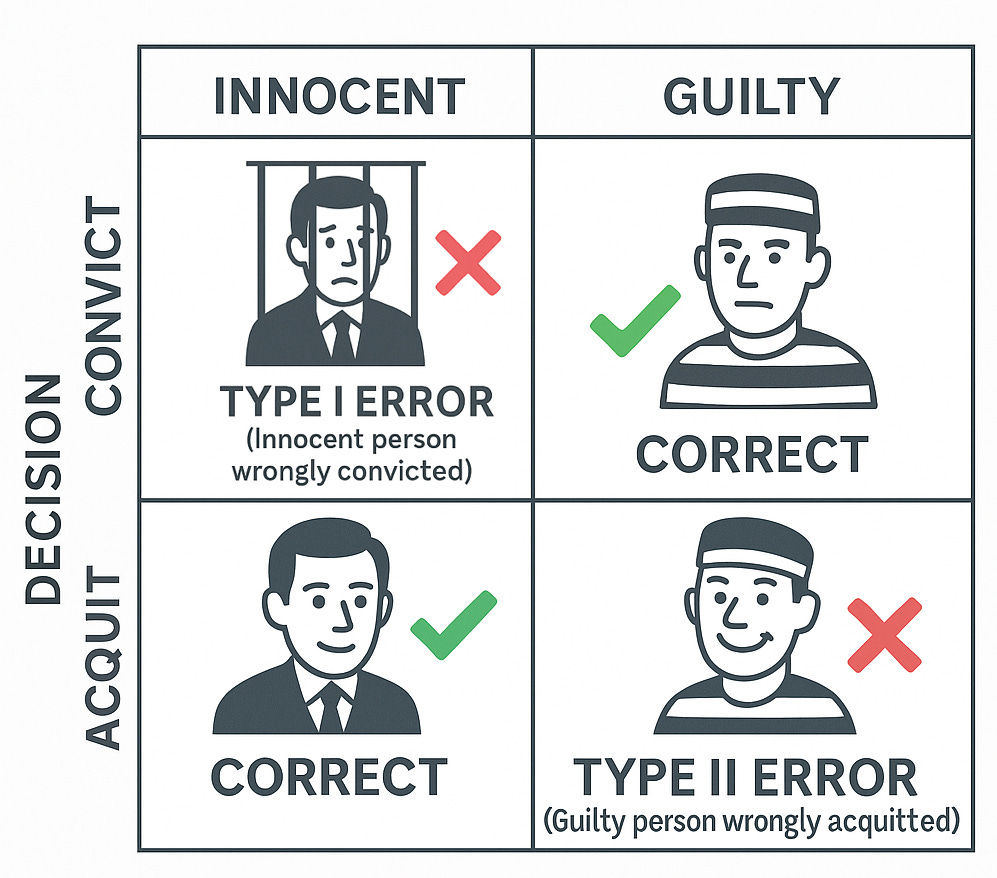
It is in a similar sense that in science we can make inferences from data about whether or not particular relations exist. For instance, when epidemiological studies investigate relations between a factor and a disease, there are four possible outcomes:
A true relation is correctly inferred (true positive, or the guilty is convicted).
A relation is incorrectly inferred when none exists (false positive, or Type I error, or the innocent is convicted).
A true relation is missed and not inferred (false negative, or Type II error, or the guilty is acquitted).
No relation is inferred, and none actually exists (true negative, or the innocent is acquitted).
Does this help?
PS
In science, we never “prove” a hypothesis—only support or refute it based on available evidence.
The legal analogy is illustrative, but in law, the burden of proof is deliberately high to avoid Type I errors (wrongful convictions), while in science, the balance between Type I and Type II errors depends on the context.